The Importance of a Village
Cassie Schutzer
Tuesday, April 21, 2026
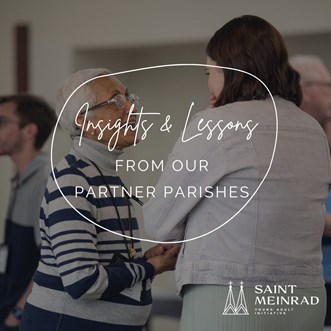
Lesson #3: Young adults desire a community that crosses generational lines.
“We need to learn how to be a village again.”
This line from one of our former partner parish ministers has stayed with me for years. For him, ministry was about creating space for people to form relationships across generations, where everyone belongs and builds up the community.
Being a village.
As Catholics, we have a deeper understanding of what it means to be a village.
In a word, Communion. Our village is the Church, the Bride and Body of Christ, united to Jesus, the Head and Bridegroom.
“Being a village” is not optional for us. It is the reason we gather around the altar to receive and become the body of Jesus Christ. The Eucharist is who we are.
This is our village, and it takes all of us showing up, consistently, and with hearts open to one another and to the Lord. We are a gift to each other, and intergenerational community – with its joys and challenges – is a testament to this truth.
We challenge and temper one another: As nice as all of this sounds, it’s important to recognize and name the challenges that come with building an intergenerational community. Age and youth can sometimes hold competing priorities, and if we don’t keep a healthy tension, we are at risk of misunderstanding or disregarding one another. Age often brings wisdom, stability, fidelity, and a long memory. But there is a risk of becoming calcified, grasping for control and becoming frightened of the future. Youth offers passion, energy, new possibilities, and openness of spirit. But the risk here is unchecked idealism, disregarding conventional wisdom without due consideration. St. Augustine, as he was falling in love with God, described Him as “beauty ever ancient, ever new.” God, who has existed before time, is always doing something new. Our Church is the same – ever ancient, ever new. We are rooted in Scripture and tradition, but we are never afraid to open ourselves to the Holy Spirit who pours out graces for the present moment. Our parishes cannot be afraid to grow young – for it is in youth that we are most like our heavenly Father. As GK Chesterton writes, “He has the eternal appetite of infancy; for we have sinned and grown old, and our Father is younger than we.”
We are a visible expression of unity: There are so many instances of division in our society, and we see this especially in how different generations speak of each other. It breaks my heart to see young people speak badly of older generations and vice versa. As mentioned above, we have a deep need for one another. We have lessons to learn and teach each other, and we are missing out on some crucial aspect of life if we are only surrounded by our peers. As the Body of Christ, we are meant to be a visible sign of unity in the world. In a time of rampant individualism, we can witness to the strength that comes from mutual dependence. In a society that glorifies youth and fears aging, we can value the wisdom that comes from experience and the inherent dignity of all life. In a world that commodifies our young people, we can provide a place for them to encounter the living God and discover their deepest identity in Him.
We were never meant to do it alone: A few years ago, I (a non-parent) attended a moms’ Bible study with a friend. I was struck by an exchange between two women – one at the beginning of her motherhood, the other enjoying the season of being “grandma.” As the young mom shared her struggles with being a stay-at-home-parent and the loneliness she experienced, the older woman observed, “You know, when I was raising my kids, I never did it alone.” There are so many people – both old and young – who feel isolated from the world. The simple truth is that we were never meant to journey alone; we weren’t made that way. We were made by a God who exists in an eternal relationship of love – Father, Son, and Spirit – and invites us to make a gift of ourselves in response to that love. I have seen so much fruit come out of intergenerational friendships. We were made for communion; we were made to be a village.
If you are looking for intentional ways to build intergenerational community in your parish, here are a few ideas other parishes have tried:
- Speed-Friending: One of our parishes hosted a speed friending social during Lent that brought together their young adult group and their “Boomers and Beyond” group. The event included a potluck dinner and guided conversation questions centered around Lenten practices, and they ended with a prayer experience in the church.
- Small Groups: Several of our parishes offer small groups that are based on topic and availability rather than age. Groups are hosted in the homes of parishioners and are a great avenue for forming deeper relationships among a smaller group of people.
- Retreats: One of our parishes has seen great success in offering an annual intergenerational women’s retreat. They put great effort into personal invitations, and several women are invited to share their testimony during the weekend. These small touches may not seem like a lot, but often the first steps to growing in communion are hospitality and vulnerability.
- “How-to” Classes: We don’t often see the parish as the place for practical life lessons, but this is a great way to start building intergenerational friendships. One parish hosted an automobile skills class, teaching young people how to check their oil, change a tire, and replace their headlight bulbs. Moments like this are starting points for building trust, and they are often appreciated by young people with limited access to their families.
There are many more ideas that are not mentioned here, but the important thing is to be intentional about prioritizing intergenerational spaces in our parishes. May the Lord continue to bless our work!
________
This year, we will be diving deeper into our 2025 insights. Each month, we will focus on one lesson our partner parishes learned and offer concrete ways to incorporate these insights into your own ministry. May God bless our work!